Let’s take a short break from the narration of our adventure inside Gabon and talk about bats today. It’s been a long time since we wanted to do so, as our closest neighbours in Libreville are bats, fruit bats to be precise. The very species that is widely talked about in these Covid-19 days. The French call it “roussette”, the Hungarians “flying dog”, the English “flying fox”. Here we have a serious colony of them, counting at least 100,000 individuals as far as our eyes can estimate.
We live on the 5th floor and our balcony overlooks what is probably the biggest jungle in Libreville. It’s thick, lush, with a mix of bamboo, palm trees, trees of an average 20 meters height, some of them going up to 50 meters. During the day, our bats nest in these trees, usually in the upper parts. There is a hierarchy system by which the more senior bats stay in the upper branches, while the younger or padawan-level bats are in the lower ones. Fruit bats do not have a sonar, but they have an excellent eyesight. They sleep by shifts of 30 to 40 min, and between these shifts they can be extremely noisy. Our 100,000 neighbours manage to sleep at the same time around 1 or 2 pm. But for most of the day, half of them are asleep while the other half is busy flying around and chatting with each other, producing 21 different types of sounds that land somewhere between the dog bark and the crow caw, not so melodic. It is visually and sonically overwhelming, but we got used to it.
We knew that bats carry hundreds of viruses, and we were concerned in the beginning that they would visit us on the balcony. But actually they have proven to be very well-behaved, and they never come too close. They do not seem very interested in human beings.
Every single day at dusk, something fascinating happens : the fruit bats are all getting really excited, they leave the trees one after the other, start flying around in sky-filling proportions. And then, as the sun is setting into the ocean, they all leave the jungle in flocks to go to their night hunting spot. It’s a beautiful and spectacular sight that we got to love:
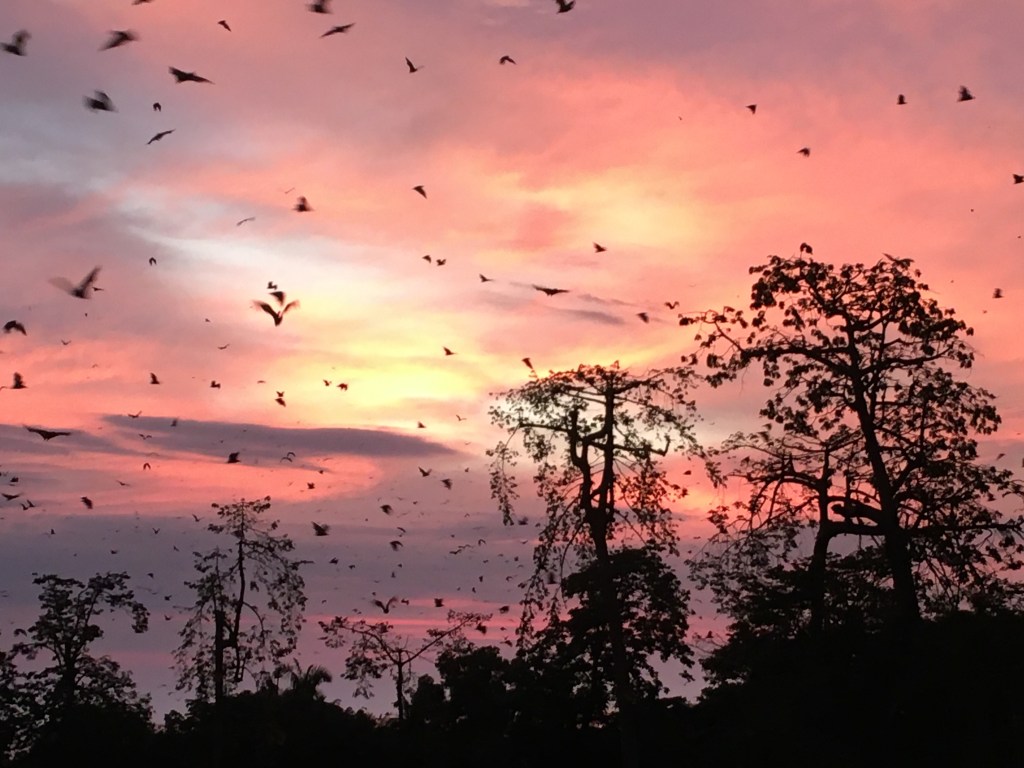
We are not sure exactly where their night hunting spot is. Some locals say they cross the estuary to go to Pointe-Denis, others say that they invade the arboretum some 15 km North… Anyhow, this has to be a spot full of insects, fruit trees, leaves and nectar. And what studies have shown is that, just like they stick to one area by day, they stick to one area by night too, with each bat having a particular tree to occupy itself with. After eating all night, they all loudly come back to our jungle at sunrise, around 6 am. Our natural alarm clock.
But on Wednesday last week, something even more fascinating happened: our natural alarm clock did not ring in the morning. Our bats never came back from their night hunt, and they have been nowhere in sight since then. Now the jungle is all empty and quiet. We do not have to close the windows in the morning to listen to music or hear each other. We hear the chirping of the birds, and we actually see more exotic birds as they seem to understand that there are available spots now in the jungle.
Where have our bats gone? We have read that there is a place in Zambia where every year in spring time millions of them are gathering for a sort of Pan-African bats conference. Perhaps that is where they are now, 4000 km away from here? We do not know. We’ll ask them when they are back in a few weeks or months from now, and we’ll keep you posted.
 Tanad stories from Gabon
Fascinating!! Lovely to hear your stories
LikeLike